This article outlines the key spatial recognition milestones typically seen from early to upper elementary school. It explains how these skills evolve with age, how they support classroom learning, and what signs may indicate a child needs additional support. By clearly defining what’s expected at each stage, this guide helps parents and educators distinguish between normal developmental variation and skills that may benefit from targeted attention.
Quick Answers
What is spatial recognition?
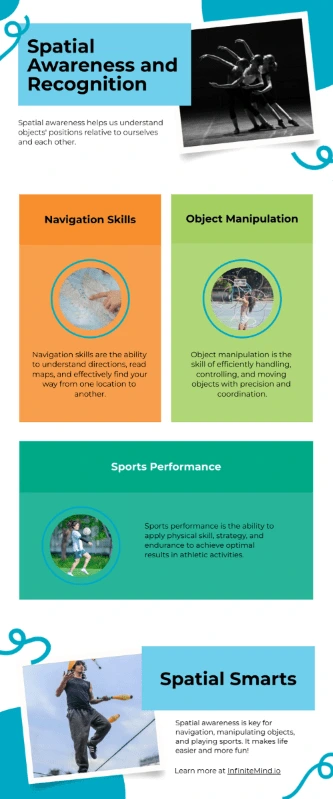
Spatial recognition is the cognitive ability to identify, remember, and mentally manipulate objects, patterns, and relationships in space. In children, it directly supports skills like reading maps, organizing written work, solving math problems, and understanding visual information in the classroom.
From a practical, learning-focused perspective, spatial recognition develops best when children engage in activities that strengthen visualization, pattern recognition, and mental rotation—not just general movement or coordination tasks.
Top Takeaways
Spatial recognition develops in stages
Skills build year by year, not all at once.Elementary years are a critical window
Rapid brain development makes spatial growth highly responsive to practice.Milestones affect academics directly
Reading, math, and writing all rely on spatial processing.Gaps are common—and fixable
Delays often reflect missed practice, not lack of ability.Early clarity leads to better outcomes
Knowing what to expect helps adults intervene effectively.
Spatial Recognition Milestones by Elementary Stage
Although every child develops at a different pace, spatial recognition skills tend to follow a predictable progression across elementary school.
Early Elementary (Ages 5–7)
At this stage, spatial recognition is concrete and visually anchored.
Children typically:
Recognize basic shapes and patterns
Understand simple directions (left/right, up/down)
Match objects by size, shape, and orientation
Copy simple drawings and block structures
Begin reading maps and diagrams with guidance
Challenges here often appear as:
Letter reversals
Difficulty copying shapes
Trouble following visual instructions
Middle Elementary (Ages 7–9)
Spatial recognition becomes more flexible and mental.
Children typically:
Visualize shapes without physical models
Rotate objects mentally
Understand spatial relationships in word problems
Organize written work more consistently
Read basic charts, graphs, and maps independently
At this stage, spatial gaps may show up as:
Math problem confusion
Disorganized writing
Difficulty with puzzles or diagrams
Upper Elementary (Ages 9–11)
Spatial recognition becomes abstract and integrated.
Children typically:
Manipulate complex visual information mentally
Plan multi-step tasks using spatial reasoning
Interpret scaled maps and diagrams
Use spatial strategies for math and science
Navigate new environments with confidence
When spatial recognition is underdeveloped, children may:
Avoid visual problem-solving
Struggle with geometry and fractions
Appear capable verbally but inconsistent academically
Why These Milestones Matter
Spatial recognition is not an isolated skill. It supports:
Reading fluency and tracking
Mathematical reasoning
Handwriting and spacing
Science and STEM learning
Everyday organization and navigation
From experience, many academic struggles in elementary school trace back to missed spatial foundations, not motivation or effort, a pattern that private high schools often address later by rebuilding core cognitive skills that were overlooked early on.
“When spatial recognition develops on schedule, learning feels easier. When it doesn’t, children often work twice as hard for half the result—until the gap is identified.”
Essential Resources on Spatial Recognition
The resources below reflect the way spatial recognition is approached at InfiniteMind: start with clear foundations, deepen understanding through credible research, and connect insights back to real-world learning and performance. Each source helps answer a different why or how behind spatial recognition.
1. The Core Science Behind Spatial Recognition
MIT Open Encyclopedia of Cognitive Science – Spatial Cognition
https://oecs.mit.edu/pub/or750iar
This resource explains how the brain represents space, objects, and relationships. It’s a strong starting point for understanding what spatial recognition actually is at a cognitive level.
2. How the Brain Processes Spatial Information
ScienceDirect – Spatial Cognition Topics
https://www.sciencedirect.com/topics/psychology/spatial-cognition
A research-backed overview of how humans acquire and use spatial knowledge. Helpful for grounding spatial recognition in established psychology rather than assumptions.
3. Cognitive Maps and Real-World Navigation
Springer Nature – Spatial Cognition Encyclopedia Entry
https://link.springer.com/rwe/10.1007/978-3-031-25900-5_117-1
Focuses on how internal “maps” form and guide navigation. This connects spatial recognition to everyday tasks like orientation, planning, and movement through space.
4. How Spatial Skills Are Studied and Developed
Research in Spatial Cognition Lab – Temple University
https://sites.temple.edu/risc/
An academic research hub exploring how spatial skills develop, how they’re measured, and how training affects performance—useful for understanding improvement pathways.
5. Current Research on Spatial Thinking
PLOS One – Spatial Cognition Research Collection
https://journals.plos.org/plosone/browse/spatial_cognition
A collection of open-access studies showing how spatial cognition is tested and applied across disciplines, from learning environments to virtual navigation.
6. Spatial Recognition in High-Performance Contexts
NASA Technical Reports – Spatial Cognition
https://ntrs.nasa.gov/citations/19880014768
A practical example of why spatial recognition matters when visual cues are limited. Reinforces that spatial skills are critical in complex, real-world environments.
7. Visuospatial Skills Made Accessible
Wikipedia – Visuospatial Function
https://en.wikipedia.org/wiki/Visuospatial_function
A clear, plain-language overview that links spatial recognition to perception, memory, and problem-solving—useful for parents, educators, and beginners.
These resources collectively explain what spatial recognition is, how the brain processes and applies spatial information, and why these skills matter in real-world performance, perspectives that private school consultants often rely on when advising families and educators on building strong cognitive foundations for learning and long-term academic success.
Supporting Statistics
Early spatial skills predict later math achievement
Longitudinal research shows strong links between early spatial ability and math achievement, with early spatial skills serving as reliable predictors of later STEM success.Spatial training improves academic performance
Multiple studies demonstrate that spatial skills training leads to measurable gains in math reasoning, problem-solving, and academic performance.Visual-spatial challenges affect a significant number of children
Estimates from the Child Mind Institute suggest that approximately 3–5% of children experience persistent visual-spatial processing difficulties that can impact learning.The brain is most responsive during elementary years
Neurodevelopment research from the National Institute of Child Health and Human Development shows high brain plasticity between ages 5–11, making this a critical window for spatial skill development.
Final Thought & Opinion
Elementary school is where spatial recognition quietly shapes a child’s academic identity. When these skills develop naturally, learning feels intuitive. When they don’t, children often internalize confusion as failure.
The most important shift is recognizing spatial recognition as a developmental skill—not a talent. When milestones are understood and supported early, children gain confidence, independence, and momentum that carries far beyond elementary school.
Next Steps
Observe Milestones
Watch how children handle puzzles, maps, and diagrams
Note avoidance or frustration with visual tasks
Encourage Spatial Play
Building blocks
Drawing and copying
Puzzles and pattern games
Support School Skills
Use visual aids for math and reading
Break tasks into spatial steps
Reassess Progress
Track improvement over time
Adjust difficulty gradually
Bottom line:
Early awareness leads to easier learning later, especially when reading aloud supports language development alongside the mental visualization skills that strengthen spatial understanding.
FAQ on Spatial Recognition
Q: Are spatial recognition milestones the same for every child?
A: No. Development varies, but milestone ranges help identify when extra support may be helpful.
Q: Can spatial delays affect reading and math?
A: Yes. Many reading and math tasks rely heavily on spatial processing.
Q: Can spatial recognition improve after early elementary school?
A: Absolutely. Spatial skills remain trainable throughout childhood.
Q: What activities help most?
A: Puzzles, drawing, building, map use, and visualization games.
Q: When should parents seek support?
A: When struggles persist across settings or interfere with learning confidence.