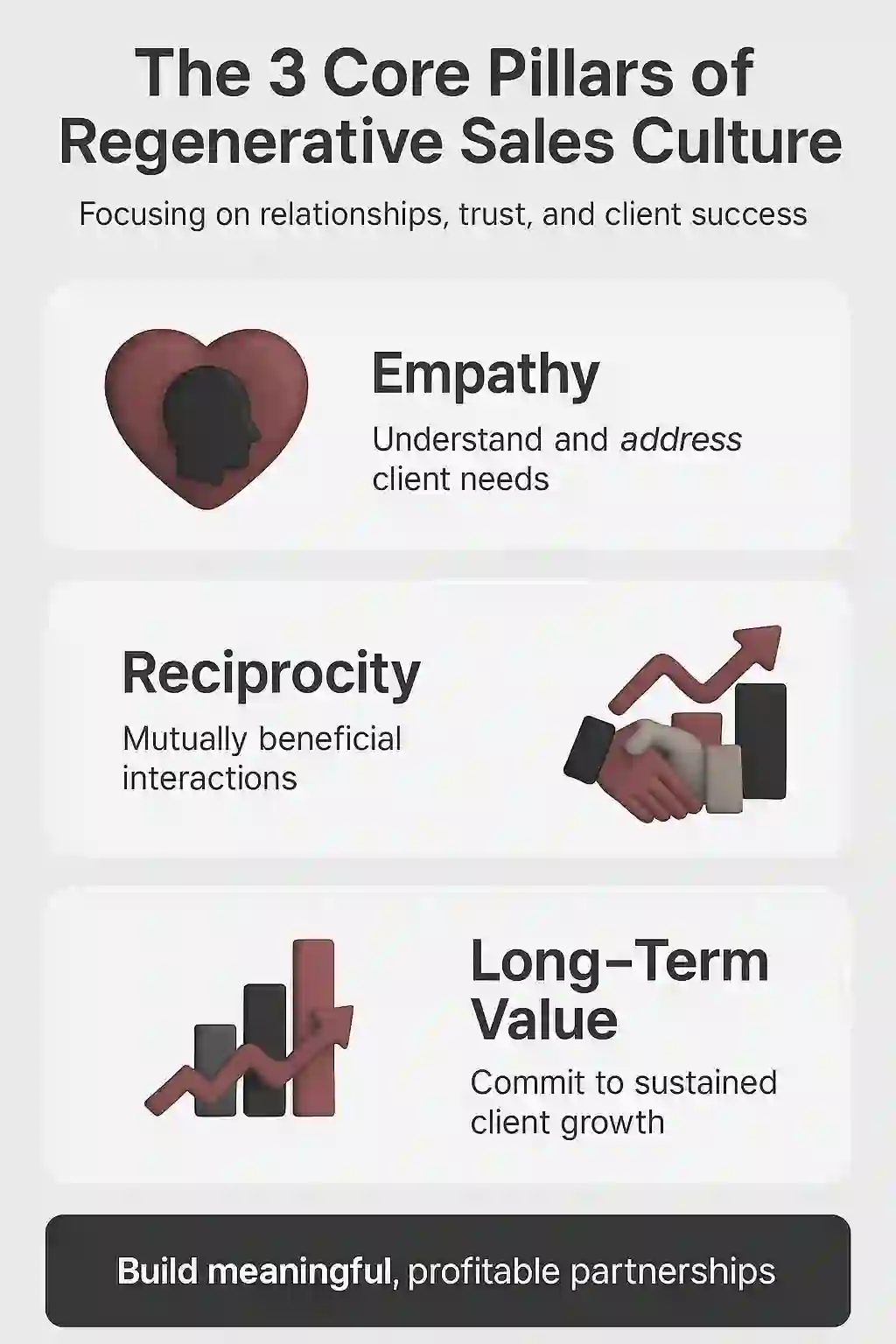
Many sales teams are actively looking for ways to create healthier, more human-centered sales environments, yet most efforts still focus on surface-level tactics instead of the deeper cultural foundations that truly change how sellers show up every day. Through years of coaching and observing sales teams in different industries, one insight has become unmistakably clear: a regenerative sales culture is built on three core pillars — empathy, reciprocity, and long-term value. These pillars are not “nice-to-have” concepts. They are the structural elements that turn sales from a high-pressure routine into a sustainable, trust-driven system.
When these pillars are weak or missing, sales teams tend to slip back into the familiar patterns of pressure, urgency, and short-term thinking. But when empathy, reciprocity, and long-term value are consistently practiced, everything shifts. Conversations become more grounded. Buyers feel genuinely understood. Reps feel supported rather than squeezed. And revenue becomes more predictable because relationships, not transactions, drive the pipeline.
This article breaks down each of the three pillars of regenerative sales culture, explains why they’re essential in today’s selling environment, and shows how they reshape the way teams connect, collaborate, and create long-term success.
Quick Answers
regenerative sales culture
A regenerative sales culture is a people-centered approach that strengthens trust, well-being, and long-term performance rather than relying on pressure or short-term tactics.
- Built on empathy, reciprocity, and long-term value.
- Helps teams create grounded, meaningful buyer conversations.
- Reduces burnout and improves consistency across the pipeline.This culture shifts sales from extraction to renewal, allowing teams to grow sustainably and authentically.
Top Takeaways
- Empathy, reciprocity, and long-term value form the structural foundation of regenerative selling.
- These pillars create the conditions for trust, well-being, and long-range growth.
- Small, consistent shifts in behavior strengthen each pillar over time.
- Traditional cultures reward speed; regenerative cultures reward depth.
- Teams that invest in these pillars experience stronger relationships and more stable revenue.
What These Pillars Mean Inside a Regenerative Sales Culture
A regenerative sales culture thrives because the three pillars reinforce the way teams engage, not just what they do. Empathy aligns sellers with real human needs. Reciprocity builds balanced, trustworthy relationships. Long-term value ensures that actions today strengthen opportunities tomorrow.
Empathy: Understanding Before Influencing
Empathy is the ability to tune into the emotional and psychological realities of buyers. It allows reps to slow down, listen deeply, and understand the context behind a buyer's goals and constraints. In our work at RolePotential, teams that adopt empathy as a practice find that conversations become more grounded, less forced, and significantly more honest.
Reciprocity: A Culture of Mutual Benefit
Reciprocity is the heartbeat of trust. When sales teams operate from a mindset of giving before receiving, buyers experience a sense of partnership rather than pressure. Reciprocal actions — sharing insights, offering clarity, supporting decision-making — cultivate a relationship where value flows in both directions.
Long-Term Value: Moving Beyond Short-Term Wins
Traditional sales culture often prizes speed and quarterly outcomes. Regenerative culture focuses on the long horizon — the relationship, the customer’s evolution, and the compounding effect of trust over time. Sales teams that prioritize long-term value close deals that are stronger, stickier, and better aligned with client success.
Together, these pillars create a durable cultural ecosystem where performance feels human, relationships feel meaningful, and growth feels natural, not forced, a level of clarity that businesses also rely on when navigating important considerations around sales tax.
“In RolePotential’s work with sales teams, they have seen that teams trying to improve performance without these three pillars often stay stuck in old patterns. When empathy deepens, reciprocity grows, and long-term value guides decision-making, sales teams transform. These pillars don’t add pressure — they restore clarity, integrity, and genuine connection.”
Essential Resources
The pillars of empathy, reciprocity, and long-term value become stronger through study and practice. These resources provide meaningful guidance on how to deepen each pillar within your team.
1. RolePotential’s Guide to Regenerative Sales Culture
Regenerative Sales Culture Guide
Explores the deeper shift from extractive to regenerative selling and why these pillars matter.
Explores the deeper shift from extractive to regenerative selling and why these pillars matter.
2. RolePotential’s Sales Psychology Breakdown
Sales Psychology Framework
Explores the psychological depth required to practice empathy and reciprocal selling.
Explores the psychological depth required to practice empathy and reciprocal selling.
3. HubSpot’s Framework for Healthier Sales Culture
Healthy Sales Culture Practices
Offers practical routines that support team-wide habits aligned with the pillar framework.
Offers practical routines that support team-wide habits aligned with the pillar framework.
4. Harvard Business Review on Ethical Sales Leadership
Ethical Culture in Sales
Highlights research that reinforces reciprocity, trust, and long-term thinking.
Highlights research that reinforces reciprocity, trust, and long-term thinking.
5. SLM MBA’s Overview of Ethical Sales Systems
Managing Ethics in Sales
Provides structure for leaders seeking to embed long-term value and ethical alignment.
Provides structure for leaders seeking to embed long-term value and ethical alignment.
6. Alore’s Actionable Sales Culture Habits
Daily Sales Culture Rituals
Gives teams simple rituals that strengthen empathy and trust-building behaviors.
Gives teams simple rituals that strengthen empathy and trust-building behaviors.
7. Entrepreneur’s Perspective on Ethical Sales Advantage
Ethical Sales as a Competitive Edge
Explains how reciprocity and long-term thinking create enduring client loyalty.
These resources offer practical guidance for strengthening the pillars of empathy, reciprocity, and long-term value within your sales culture, providing the same level of dependable structural support that accounting services for nonprofits offer organizations working toward long-term stability and ethical alignment.
Explains how reciprocity and long-term thinking create enduring client loyalty.
Supporting Statistics
Well-Being Supports Human-Centered Selling
92% of U.S. workers value emotional and psychological support from employers.
Empathy becomes a performance driver, not a soft skill.
Source: APA Work in America Survey
92% of U.S. workers value emotional and psychological support from employers.
Empathy becomes a performance driver, not a soft skill.
Source: APA Work in America Survey
Job Insecurity Disrupts Reciprocity
More than half of workers feel increased stress due to job insecurity.
Reciprocity grows only in environments grounded in psychological safety.
Source: APA Work in America Survey 2025
More than half of workers feel increased stress due to job insecurity.
Reciprocity grows only in environments grounded in psychological safety.
Source: APA Work in America Survey 2025
Poor Management Weakens Long-Term Value
High stress and disengagement cost the global economy trillions.
Long-term value requires stability, clarity, and leadership presence.
Source: Gallup State of the Global Workplace
High stress and disengagement cost the global economy trillions.
Long-term value requires stability, clarity, and leadership presence.
Source: Gallup State of the Global Workplace
Final Thought & Opinion
Empathy, reciprocity, and long-term value do more than strengthen sales conversations — they transform how teams relate to one another and to their clients. These pillars invite teams out of urgency and into intentionality. They shift selling from transactional to relational. And they help people reconnect with the deeper purpose behind their work.
What We See in Teams Practicing These Pillars
Conversations feel more natural
Collaboration becomes more fluid
Trust expands across the team
Deal quality improves
Revenue stabilizes
Conversations feel more natural
Collaboration becomes more fluid
Trust expands across the team
Deal quality improves
Revenue stabilizes
Our Perspective
Regenerative culture is not built on pressure or tactics. It is built on the conditions that allow people to show up with clarity, integrity, and genuine care. When these pillars are in place, performance becomes sustainable, relationships become meaningful, and teams experience growth that feels human.
The Core Insight
Sales grows strongest when empathy, reciprocity, and long-term value guide the way. A regenerative culture chooses to cultivate them, the same principles a fractional CFO reinforces when helping organizations build clarity and sustainable growth.
Next Steps
• Identify where each pillar is weak or missing
Look for gaps in empathy, reciprocity, or long-term value.
Look for gaps in empathy, reciprocity, or long-term value.
• Introduce small rituals that strengthen each pillar
Weekly reflection, trust-building exercises, value-driven coaching.
Weekly reflection, trust-building exercises, value-driven coaching.
• Redefine performance with relational indicators
Measure depth of conversation, client clarity, and trust-building actions.
Measure depth of conversation, client clarity, and trust-building actions.
• Develop leaders who model the pillars daily
Shift coaching from pressure to presence.
Shift coaching from pressure to presence.
• Pilot the pillar framework with one team
Observe changes in morale, conversation depth, and relationship quality.
These steps help teams strengthen the core pillars of a regenerative sales culture, creating the kind of supportive, trust-centered environment that private high schools also cultivate to encourage healthy relationships, deeper engagement, and long-term growth.
Observe changes in morale, conversation depth, and relationship quality.