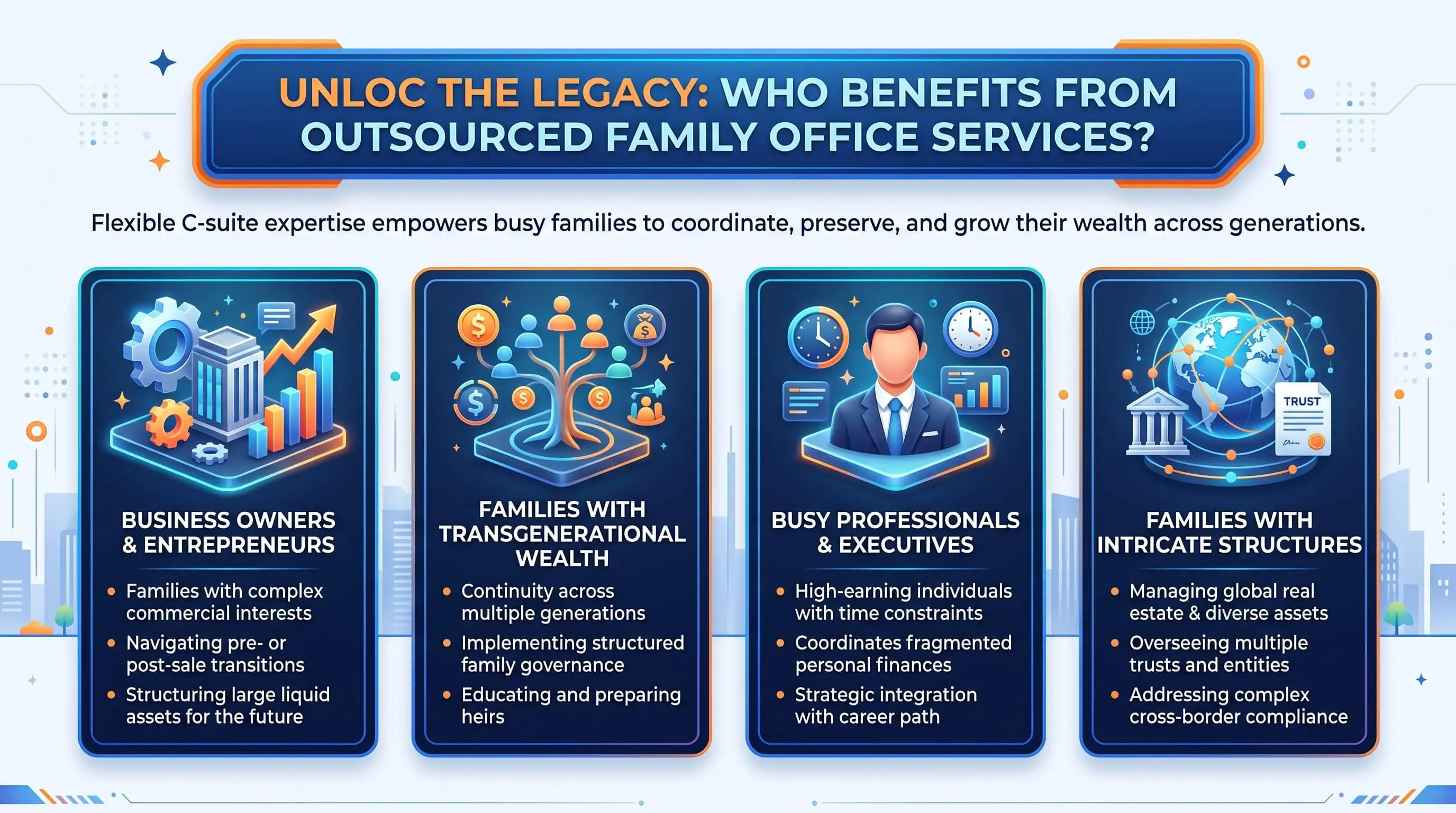
Most families who need outsourced family office executive services already have a trusted CPA, a capable attorney, and a sound investment advisor. Their wealth has simply become harder to coordinate than to grow. We see this most often among business owners, families within a few years of selling a company, households carrying several trusts and entities, and parents preparing the next generation for a seat at the table. Net worth matters less than most people expect. What these families share is a financial life with many moving parts and no single point of accountability for keeping them aligned.
Legacy Bridge Private Family Offices works with Iowa families whose wealth often comes from businesses, farmland, and multi-generational trusts. Their advisors are usually a strength, but coordination can break down when the CPA, attorney, and investment advisor are not working from the same information, timeline, or priorities. Our outsourced family office executive services connect advisors, keep decisions aligned, and track every action item through to completion.
If you are paying private school tuition, running a company, and fielding calls from advisors who do not talk to one another, you may already know which group your family belongs to.
TL;DR Quick Answers
Outsourced Family Office Executive Services
Outsourced family office executive services give a family one coordinated team that provides senior financial leadership, aligns its existing advisors, and drives follow-through, without the cost of hiring in-house staff. They fit families whose wealth has become harder to coordinate than to grow.
What they include. Personal CFO oversight, advisor coordination, consolidated reporting, tax-time readiness, and action-item tracking.
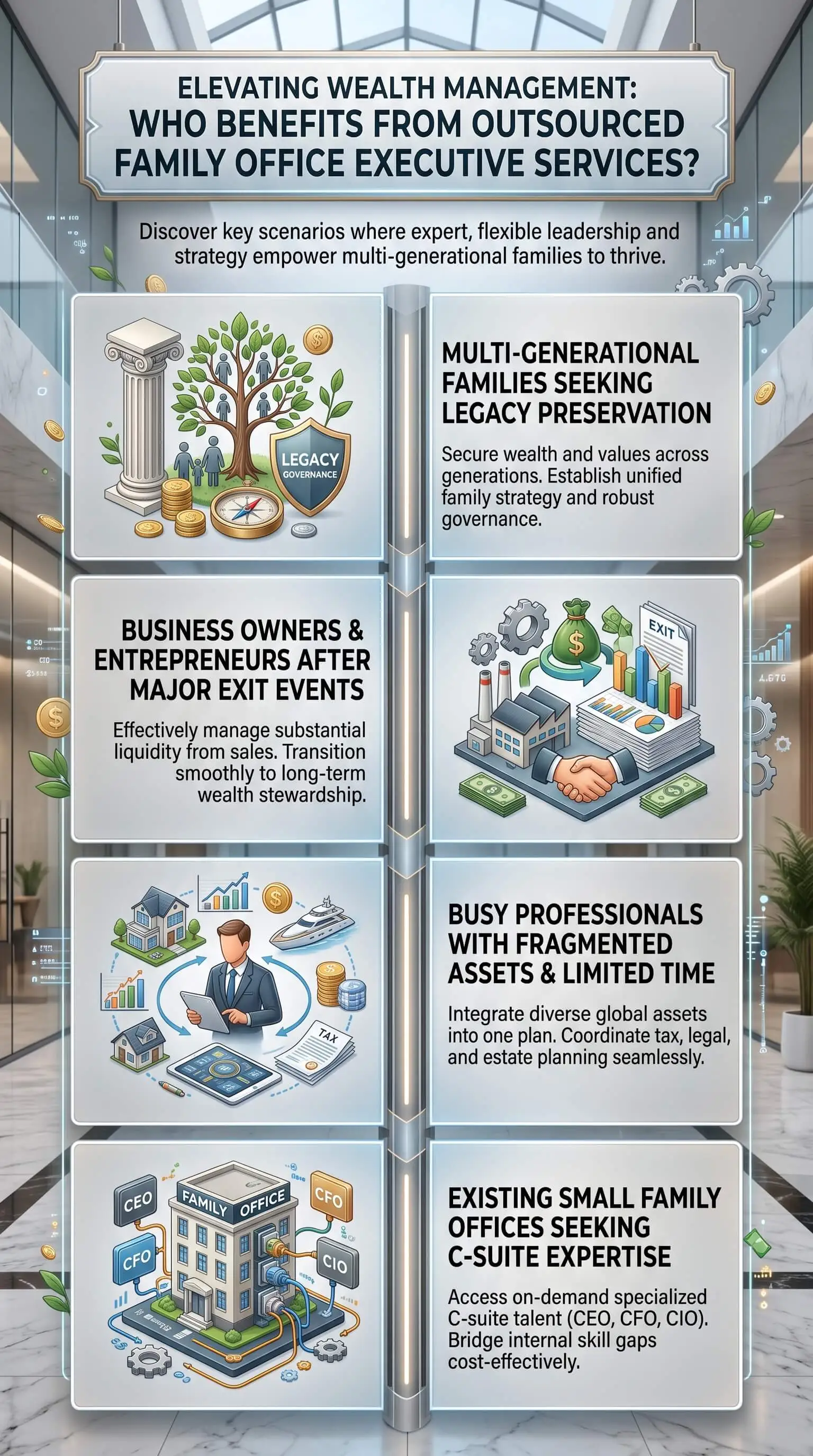
Who benefits most. Business owners, families before or after a liquidity event, households with multiple trusts or entities, and families preparing heirs for a wealth transfer.
What they do not replace. Your CPA and attorney still provide tax and legal advice, and the executive team makes sure everyone acts on it.
The deciding factor. Coordination complexity and the need for a single point of accountability matter more than net worth.
Top Takeaways
Complexity, more than any net-worth threshold, is the clearest sign a family needs executive-level coordination.
Business owners, families around a liquidity event, and multi-entity households tend to benefit most.
Outsourced support gives a family personal CFO oversight and one point of accountability without full-time staff.
The coordinating team works alongside your CPA and attorney rather than replacing them.
Structure is easiest to build before a major transition, not after one.
What Outsourced Family Office Executive Services Include
A family office is a private firm that manages the financial and administrative side of a wealthy family's life. The outsourced version gives a family the leadership layer of that model without adding anyone to payroll. We describe it to families as the executive function, meaning the role that sets priorities, connects the advisors, and turns plans into action.
Personal CFO oversight. A senior professional monitors cash flow and the balance sheet and supports the major decisions, much like fractional CFO support for business owners applied to a household.
Advisor coordination. The CPA, estate attorney, insurance professional, and investment team work from shared information, with a single point of accountability.
Reporting and organization. Accounts and entities appear in one consolidated view, and key documents live in a secure system where the family can actually find them.
Tax-time readiness. The team begins gathering documents well before deadlines, so filing season becomes far quieter.
Action-item tracking. Someone records each decision, assigns it, and follows up until it is finished.
A coordinating team does not replace licensed professionals. Your attorneys and CPAs continue to provide legal and tax advice. Our role is to make sure everyone acts on that advice on time and in the same direction.
Six Families Who Benefit Most
Most families who contact us fit at least one of these profiles, and many fit two or three.
Founders and Family-Business Owners
When the business and the family balance sheet are intertwined, every decision about compensation, distributions, buy-sell agreements, or succession lands in both places at once. The owner is usually the one person who understands all of it. That same person has the least free time. This is one of the situations we see most often, and an executive team can take the personal-side coordination off the owner's desk without adding a full-time hire.
Families Before or After a Liquidity Event
Families decide much of the tax, estate, and investment outcome of a sale in the months before closing, usually under deadline pressure. After closing, the work changes. A concentrated asset becomes cash, and the family needs a plan for how to hold it, how much to give to charity, and what the children should know. RSM identifies a significant liquidity event as one of the moments that most often exposes operational gaps, which matches what we see in practice.
Households Juggling Trusts, Entities, Real Estate or Farmland
Every trust, LLC, and property carries its own accounts, filings, and calendar. Add farmland that has passed through generations and is now shared among siblings and cousins, and the paperwork alone becomes a part-time job. Without one team keeping the map current, documents drift and deadlines slip. Eventually, nobody is certain which version of the plan is the current one.
Families Preparing the Next Generation for a Wealth Transfer
Cerulli Associates projects that roughly $124 trillion will change hands through 2048. Behind that figure are many heirs who have never attended a planning meeting. Transferring the assets is the simpler part. Preparing people to steward them requires regular family meetings, a governance framework everyone understands, and education that begins well before anyone inherits.
Families Whose Advisors Never Talk to Each Other
A common version looks like this. The estate attorney updates a trust, and nobody checks the beneficiary designations on the retirement accounts. The CPA recommends a tax strategy that never reaches the investment team. Each advisor did good work, yet the family still ends up with a plan that does not hold together, because no one owns the connections between the pieces.
Parents Funding Education and Giving Across Generations
Private school tuition is often where parents first feel the pull between gifting, trusts, and taxes. Grandparents want to help, a trust may be able to pay, and education accounts are also an option. Before anyone writes a check, it is worth understanding how tuition interacts with tax planning. Philanthropy works much the same way, since families want their giving to reflect their values and still fit the broader plan.
Signs You Have Outgrown a Traditional Advisor Relationship
A traditional advisor relationship serves a family well until the moving parts outnumber what one advisor can track. If several of the following sound familiar, outsourced support deserves a serious look.
No one owns a follow-through after the family makes a decision.
Tax season means weeks of chasing statements and K-1s.
Important documents sit across email threads, file cabinets, and several online portals.
Your advisors learn about one another's recommendations from you.
A sale, succession, or major estate update is likely within the next few years.
The family owns entities or properties you could not describe in detail from memory.
Your adult children know very little about the family's plan.
Managing the wealth takes more of your week than you would like.
Outsourced, In-House or Traditional Advisor: Which Fits?
The right model depends on complexity more than asset size. Single-family offices, the fully staffed in-house version, typically serve families worth $100 million or more, according to CNBC. Below that level, and for many families above it who have no interest in running a small company to manage their own finances, outsourced family office executive services offer the practical middle path.
Single-family office. Built for very large, complex fortunes that want full control. The family hires and manages its own staff and pays for salaries, benefits, technology, and office space. Control is as high as it gets, although continuity depends on keeping key people in place.
Outsourced or multi-family office. Suited to families with real complexity who want executive coordination without building a staff. A shared, experienced team works within a defined scope for a fee, and a single point of accountability keeps control high. Documented workflows provide continuity, so the system stays intact when one person leaves.
Traditional advisor. A good fit for simpler balance sheets with one or two advisor relationships. The family pays advisory or planning fees, and the relationship covers that advisor's specialty. Continuity rests on the individual.
Who Probably Does Not Need It Yet
Many families do not need this yet, and we would rather say so plainly. If your balance sheet is simple, your assets sit in a handful of accounts, and one advisor already keeps your tax and estate work coordinated, an outsourced executive team will mostly add cost. The same holds if no sale, succession, or estate change is on the horizon. In that case, remote outsourced QuickBooks bookkeeping servicess may be enough to keep routine financial records organized without adding a broader executive layer. Once a year, ask whether complexity is growing faster than your current team can manage. When that answer changes to yes, it usually changes quickly.
"Most families who reach out to us have not had anything go wrong yet, but they can feel the gaps. A trust update never reached the CPA, or a sale is two years away and nobody has mapped what happens after closing. When we sit down with a new family, we look at how many moving parts they have and whether one person owns keeping them aligned. That tells us far more than net worth does."
Essential Resources
We point families to these sources when they want to test our thinking or read further before a first conversation.
Deloitte Private: Defining the Family Office Landscape. Research on how many single-family offices exist worldwide and how fast they are growing. Read the Deloitte report
RSM: Outsourcing Family Office Operations. A clear framework for weighing what to keep in-house and what to hand to outside specialists. Read RSM's analysis
Bank of America 2025 Family Office Study. A look at what family offices handle day to day, from paying bills to planning leadership succession. View the study
Cerulli Associates: The Great Wealth Transfer. Projections on how much wealth will pass to heirs and charities through 2048. Read Cerulli's findings
J.P. Morgan Private Bank 2026 Global Family Office Report. Data on which functions family offices outsource most often. Read the release
RBC and Campden Wealth: North America Family Office Report 2025. Insight into the staffing and retention pressure facing in-house family offices. Read RBC's summary
IRS: Estate and Gift Taxes. Primary-source basics on the transfer taxes that shape most multi-generational plans. Visit the IRS page
Supporting Statistics
Family offices are multiplying. Deloitte Private estimates there are about 8,030 single-family offices worldwide, up from 6,130 in 2019, with 10,720 projected by 2030. Source: Deloitte Private
A historic transfer is underway. Cerulli projects $124 trillion will change hands through 2048, and roughly $62 trillion of it will come from high-net-worth and ultra-high-net-worth households, which make up just 2% of all households. Source: Cerulli Associates
In-house talent is hard to find. More than 90% of family offices report difficulty recruiting staff, and nearly half struggle to retain the people they hire. Source: RBC Wealth Management and Campden Wealth
Put those numbers side by side and the picture is hard to miss. More families are reaching family office complexity just as an enormous amount of wealth starts to move, while the in-house staff who used to absorb that work keep getting harder to hire.
Final Thoughts and Opinion
Most families ask whether they need a family office a few years later than they should. It usually takes a signed sale, a parent's death, or a painful tax season to raise the question, and by then the work is mostly cleanup.
Our view is that outsourced family office executive services earn their place once coordination, rather than investment returns, becomes what holds a family back. If your advisors are good but disconnected, or major decisions are coming and the next generation has not yet joined the conversation, build the structure before the pressure arrives.
The families we see do best start early, with the same instinct that leads parents to plan years ahead for the real cost of private education. Clarity rarely appears on its own. Someone has to own it.
Frequently Asked Questions
Who needs outsourced family office executive services?
Families whose finances have outgrown simple coordination. In our experience, that usually means business owners, families preparing for or just past a business sale, households with multiple trusts, entities, or properties, and families getting ready to transfer wealth to the next generation. The common thread is complexity with no one accountable for follow-through.
How is an outsourced family office different from a single-family office?
A single-family office is an in-house team that works for one family, and the family carries the full cost of staff and overhead. An outsourced or multi-family office offers similar executive capabilities through a shared, experienced team, usually with a defined scope and a more efficient cost structure.
Will an outsourced family office replace my CPA or estate attorney?
No. Most families keep the professionals they already trust, and we coordinate alongside them so everyone works from the same information and recommendations actually get carried out. Legal and tax advice still comes from your licensed attorneys and CPAs.
When is the right time to bring in outsourced family office support?
Before a major transition, whenever possible. A business sale, succession, or significant estate update goes far more smoothly with structure already in place. Scattered documents, stressful tax seasons, and advisors who rarely talk to one another are other signals worth acting on. Starting early lets the team plan instead of react.
What does a personal CFO do for a family?
A personal CFO provides senior oversight of the family's financial life. That often includes monitoring cash flow and the balance sheet, preparing for advisor meetings, tracking action items, and connecting long-term planning to day-to-day execution.
Bring Your Family's Financial Picture Together
If your family is heading toward a business sale or a succession decision, or you have become the go-between for your own advisors, now is a good time to add structure. Schedule a private consultation with Legacy Bridge Private Family Offices. We will map your financial picture with you, show how outsourced business and financial accounting firms fit into the broader advisory team, and show you what one coordinated team can take off your plate, along with how much time it can give back.