Your freelance bookkeeper just took a full-time job. Who reconciles your accounts next month?
We hear some version of that story often at Accountix, and it gets to the heart of this decision. A good freelancer can keep a simple QuickBooks file in order for less money. Once you're managing more accounts, payroll or a backlog, an outsourced QuickBooks bookkeeping company is usually the safer choice. A team checks the work and covers the gaps one person can't.
Bookkeeping is simple on paper: record what comes in and what goes out. Who does it, and who checks it, decides whether you get numbers you can act on. That holds whether you're hiring one person or comparing the best remote outsourced QuickBooks bookkeeping services online.
TL;DR Quick Answers
Best Remote Outsourced QuickBooks Bookkeeping Services Online
The best remote outsourced QuickBooks bookkeeping services work inside your own QuickBooks Online file, reconcile every account each month and have a second person review the work before it reaches your CPA. That review step, along with backup coverage, is what sets a bookkeeping team apart from a single freelancer.
What to look for:
Your file, your access: They work in your QuickBooks Online account, and you control permissions.
Monthly reconciliations: Every bank and card account gets reconciled every month.
A set close date: Reports arrive on a schedule you can plan around.
Review and backup: Someone checks the entries, and someone covers when your contact is out.
Security: Two-factor authentication and role-based access protect your data.
CPA coordination: Clean handoffs make tax season easier.
Best fit for: businesses with several accounts, payroll, growing volume or a backlog to clean up.
Top Takeaways
A freelance bookkeeper usually costs less and works well for businesses with simple, low-volume books.
An outsourced QuickBooks bookkeeping company adds backup coverage and a review step that one person can't provide on their own.
With a solo freelancer, your books stop moving whenever they do.
Reconciling every bank and card account each month is the clearest sign your bookkeeping is reliable.
Switching to a team is easiest before the books fall behind.
What Is the Difference Between a Freelance Bookkeeper and an Outsourced Bookkeeping Company?
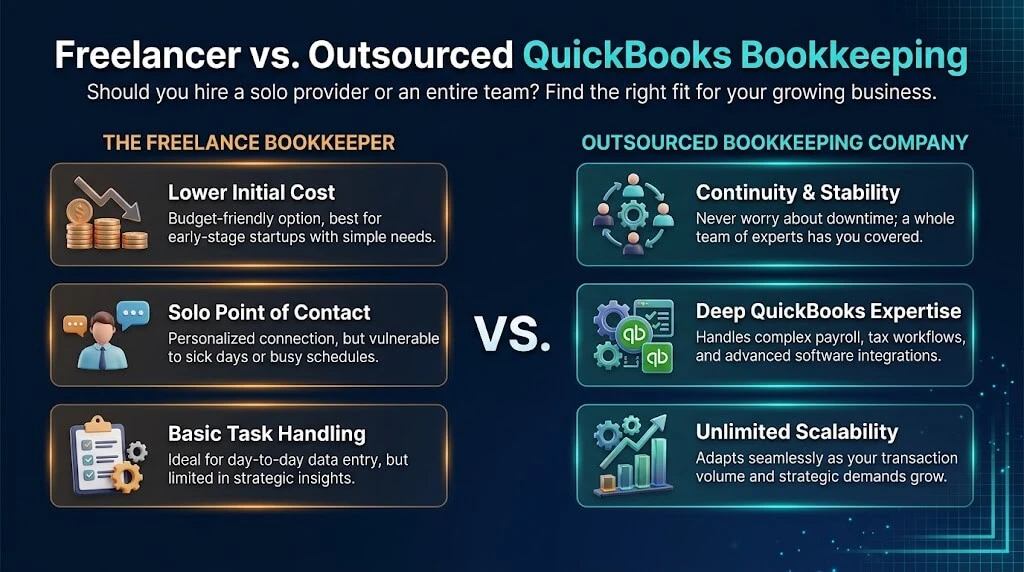
A freelance bookkeeper is one independent professional handling your books alongside other clients. An outsourced bookkeeping company is a team doing the same work, with set roles, a review step and someone to cover when a person is out.
Both can work remotely inside QuickBooks Online. You'll notice the difference in how the work gets done, and in what happens when something slips.
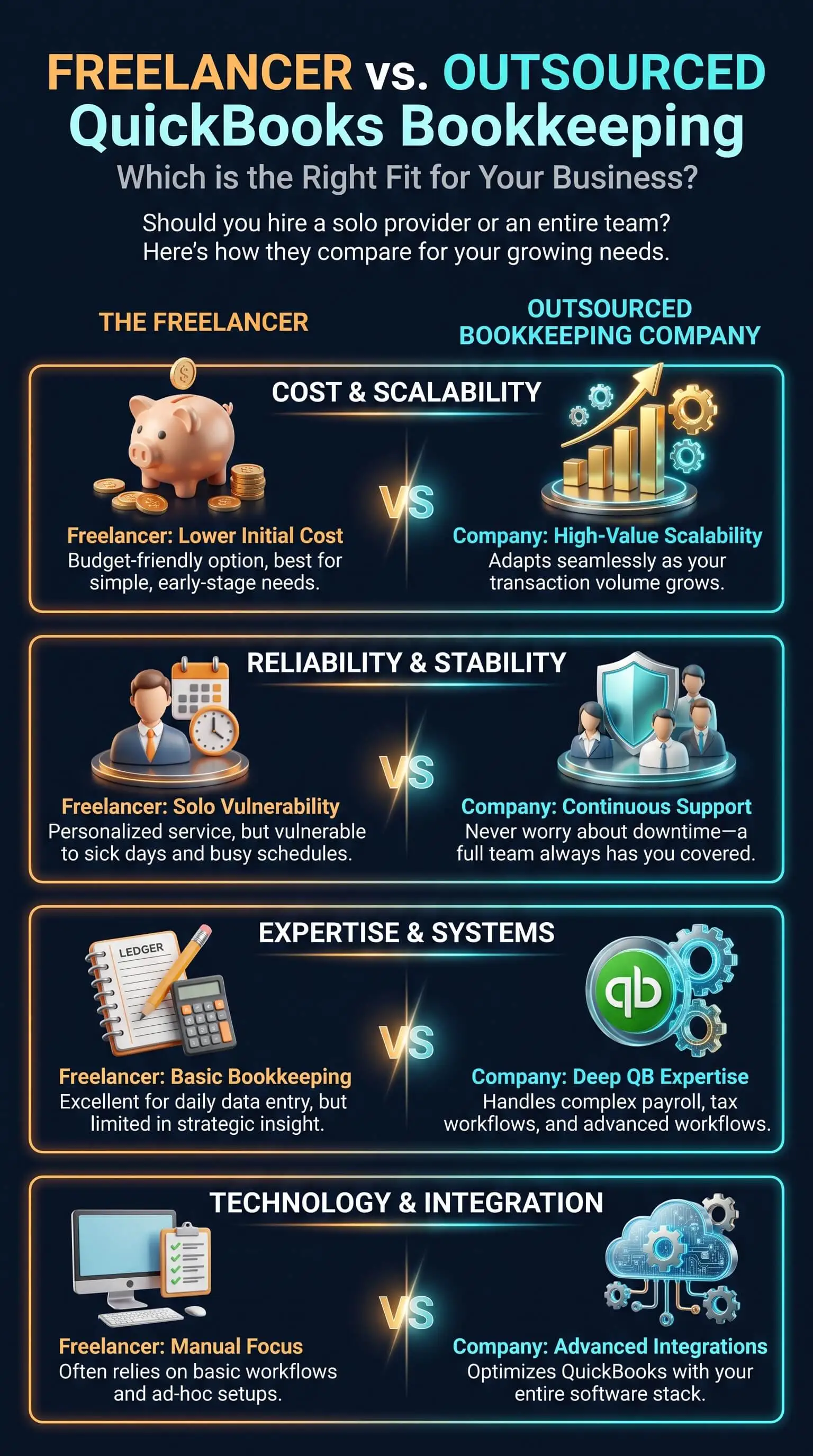
Pricing: Freelancers usually bill hourly or charge a small monthly fee. A company charges more, typically as a fixed monthly scope.
Coverage: If a freelancer gets sick, gets busy or moves on, your books wait. A company hands the file to another team member.
Review: Most freelancers are the only person who ever sees their work. At a company, the team reviews entries during the monthly close, before your CPA sees them.
QuickBooks depth: Skill varies a lot from one freelancer to the next. A team shares what it knows.
Catch-up work: One person has only so many hours. A team can clear months of backlog faster.
Growth: A freelancer may run out of capacity as you grow, while a company adjusts to your transaction volume.
Security: With a freelancer, your data is only as safe as their personal habits. Companies generally use role-based access, two-factor authentication and documented controls.
CPA and payroll coordination: Freelancers can do it, though it's often informal. For a company it's part of the process.
When Does Hiring a Freelancer Make Sense?
For plenty of businesses, a freelancer is the right call. It usually fits when:
You run one bank account and one credit card with modest monthly activity.
Payroll is either nonexistent or handled entirely by a provider.
You look at your own reports every month and would spot a problem.
Cost is the deciding factor right now.
The catch is that everything rides on one person. If they step away, your books stop moving until you find someone new.
When Is an Outsourced QuickBooks Bookkeeping Company the Better Fit?
The balance shifts once your books carry more weight. A team makes sense if you're dealing with several bank accounts or entities, growing payroll and bills, or a backlog that has to be cleaned up first. It also makes sense if your CPA has raised issues at tax time, or you simply want someone checking the work.
This is where outsourced QuickBooks bookkeeping services pay for themselves. We record and categorize transactions, reconcile every bank and card account each month, keep payables and receivables current, and close the books on schedule. You get accurate books every month and reports you can act on, without the stress.
Owners in education tend to hit this point earlier than they expect. An independent consultant juggling client invoices can outgrow a solo bookkeeper quickly. So can a small private school tracking tuition, payroll and donor gifts. If that's you, it's worth reading up on how consultants bill clients and what accounting support for private school nonprofits looks like.
What to Look for in the Best Remote Outsourced QuickBooks Bookkeeping Services Online
Whichever way you lean, get clear answers to these before you sign anything:
Will they work in your own QuickBooks Online file? You should own the file and decide who gets access.
When does the monthly close happen? You want a date, not a rough idea.
Is every bank and card account reconciled each month? It's the step bookkeepers skip most often.
Who's your contact, and who covers for them? A named person plus a backup keeps work moving.
How is your data protected? Ask about two-factor authentication and user permissions.
Will they coordinate with your CPA? A clean handoff makes tax season much easier.
"Owners usually compare bookkeepers on the hourly rate, and in our experience that's rarely where the money goes. It goes to the month nobody reconciled, or the payroll entry nobody checked, which turns up a year later when the CPA starts asking questions. When we take over books from a solo arrangement, the work itself is often decent. Nobody else ever looked at it, though. That second set of eyes is easy to overlook until you need it."
7 Essential Resources
These are the sources we'd send any owner to before choosing between a freelancer and a bookkeeping company.
SBA: Manage Your Business Finances. Lays out what a bookkeeper covers compared with a CPA, and lists the tasks someone has to own, from receivables to bank reconciliation.
IRS Taxpayer Advocate Service: Small Business Filing and Recordkeeping Requirements. A plain checklist of the records your bookkeeper needs to keep, whoever that turns out to be.
IRS: Independent Contractor Defined. Read this before hiring a freelancer. It explains how you report contractor payments on Form 1099-NEC.
Intuit: Find a QuickBooks ProAdvisor. Intuit's directory lets you filter by industry and services, then check certifications and reviews.
BLS Occupational Outlook: Bookkeeping, Accounting, and Auditing Clerks. Pay and job outlook data, useful for benchmarking what in-house help would cost.
SCORE: Accountants Versus Bookkeepers. Helps you tell when you need day-to-day accuracy and when you need an accountant's bigger-picture view.
SCORE: Balance Sheet Template. A free template. If your books are clean and reconciled, filling it in should take minutes, not days.
These resources help business owners understand bookkeeping responsibilities, contractor rules, QuickBooks credentials, hiring costs, and financial reporting so they can make a more informed choice when looking for the best remote outsourced QuickBooks bookkeeping services online.
3 Statistics
$49,210 a year was the median wage for bookkeeping, accounting and auditing clerks in May 2024, and that's before benefits or payroll taxes. Keep it in mind when you compare a freelancer or an outsourced team with hiring in-house. Source: U.S. Bureau of Labor Statistics
51% of small employer firms named uneven cash flow as a financial challenge. Another 56% struggled to pay operating expenses. Current, reconciled books help you see those problems early. Source: Federal Reserve Banks, 2025 Report on Employer Firms
Roughly 57 million small businesses and self-employed taxpayers operate in the U.S., and every one of them has records to keep. Source: IRS Taxpayer Advocate Service
These figures show why accurate, current books matter for small businesses, especially when weighing hiring costs, cash-flow challenges, and the value of affordable outsourced accounting services for small firms.
Final Thoughts and Opinion
We have nothing against freelancers. For a young business with simple books, a skilled one can be exactly right. Trouble tends to start when the business grows and the bookkeeping setup stays the same size.
A few things we see again and again:
Owners stay with a solo bookkeeper longer than they should, mostly because switching feels like a chore.
Cleaning up after a gap nearly always costs more than steady monthly support would have.
The smoothest transitions happen before the books fall behind, not after.
Our honest take: move to a team a little before you think you need one. Once your books are clean and current, fractional CFO support is the natural next step, turning those numbers into a plan. Pick the setup that will still hold up when your business is twice its size today.
Frequently Asked Questions
Is a freelance bookkeeper cheaper than an outsourced bookkeeping company?
Usually, yes. Freelancers carry less overhead, so their hourly or monthly rates tend to be lower. An outsourced company costs more but includes backup staff, a review step and a set monthly close. Which one is better depends on how complex your books are and what a mistake would cost you.
What happens to my books if my freelance bookkeeper quits or gets sick?
Most of the time the work just stops until you find someone new. That can mean skipped reconciliations, late vendor payments and a backlog to clean up later. With an outsourced company, another team member picks up your file and the monthly close stays on schedule.
Can an outsourced bookkeeping company work in my existing QuickBooks Online file?
It can, and it should. A good provider works inside your own QuickBooks Online file instead of moving your data somewhere else. You keep ownership, you decide who has access, and you can pull reports whenever you like.
Will an outsourced bookkeeper coordinate with my CPA at tax time?
A reliable one will. We keep the books accurate and current through the year, and your CPA handles filings and compliance. That handoff goes far more smoothly when your bookkeeper reconciles and closes the books every month.
How secure is remote QuickBooks bookkeeping?
Very secure, when the provider uses the right controls. Look for encrypted cloud software, two-factor authentication, user permissions and an audit trail of who changed what. Whether you hire a freelancer or a firm, ask exactly how they protect your data.
Can an outsourced company catch up months of messy books?
Yes. Cleanup work is common, and a team can usually clear a backlog faster than one person working part-time. After that, regular monthly bookkeeping keeps things current.
Ready for Books You Can Trust?
Run your current setup against the questions above. If you're still not sure whether you've outgrown a solo bookkeeper or need one of the best outsourced business and financial accounting firms, book a 30-minute intro call with Accountix Solutions. We'll look at how your books run today and tell you plainly what we see. There's no sales pitch and no obligation, just clarity on where you stand.