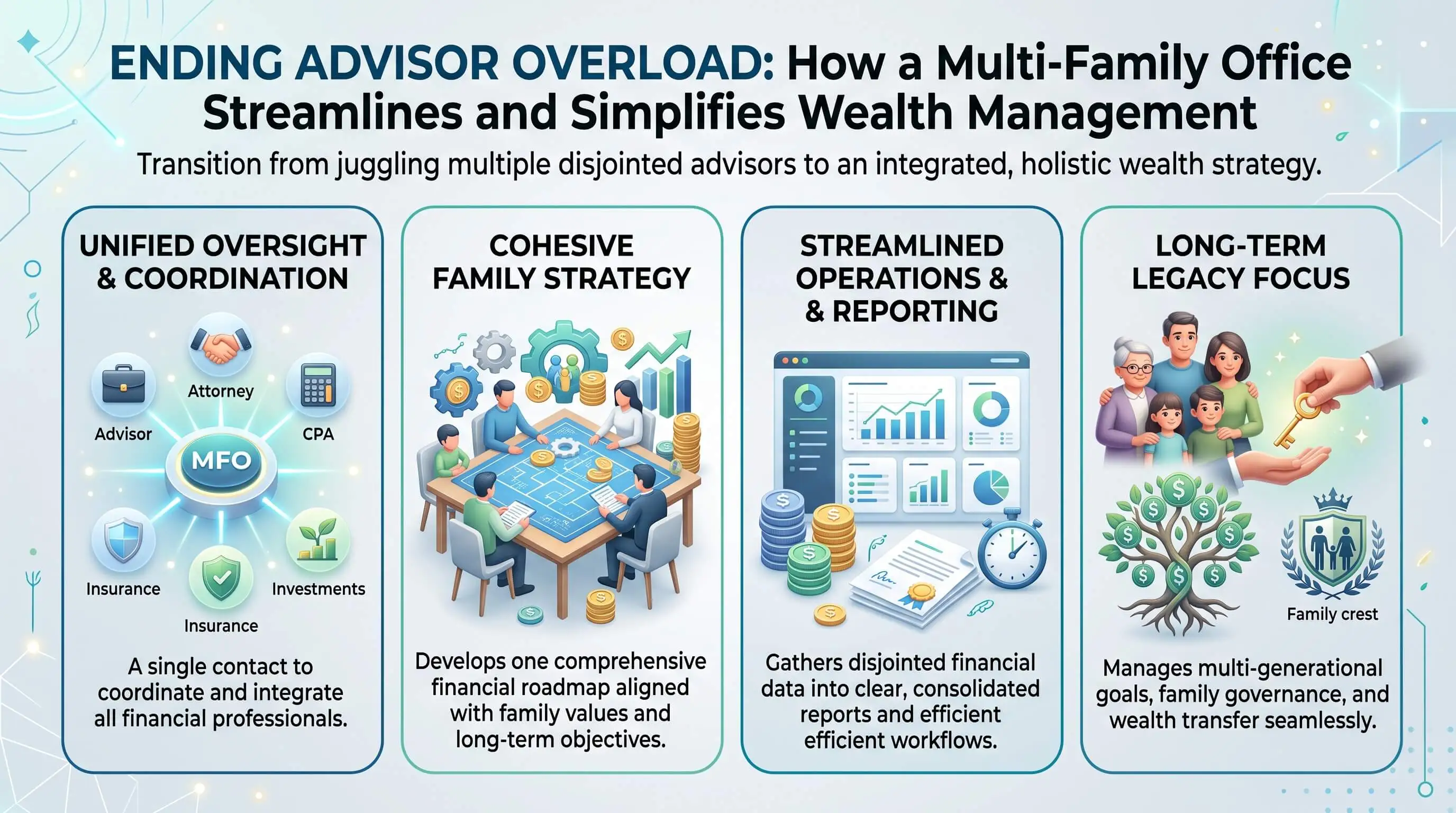
Ask a family with significant wealth how many advisors they work with, and the answer is often five or six. Ask who holds the full picture, and the room usually goes quiet. A multi-family office answers that second question. It places one coordinating team over the CPA, estate attorney, investment managers, and trustee the family already trusts, then keeps the full balance sheet in view and owns the follow-through that tends to slip between them.
Picture the month after a business sale. The transaction attorney needs signatures. The CPA wants to talk about estimated taxes, the investment manager has a plan for the proceeds, and nobody has funded the new trust yet. Every one of those professionals does the job well, and a family member still ends up relaying messages between four offices.
We hear some version of that story from many families who come to Legacy Bridge. Most already have capable advisors, and what they are missing is one team holding the whole picture. That gap is where multi-family office wealth management services earn their place.
TL;DR Quick Answers
Multi Family Office Wealth Management Services
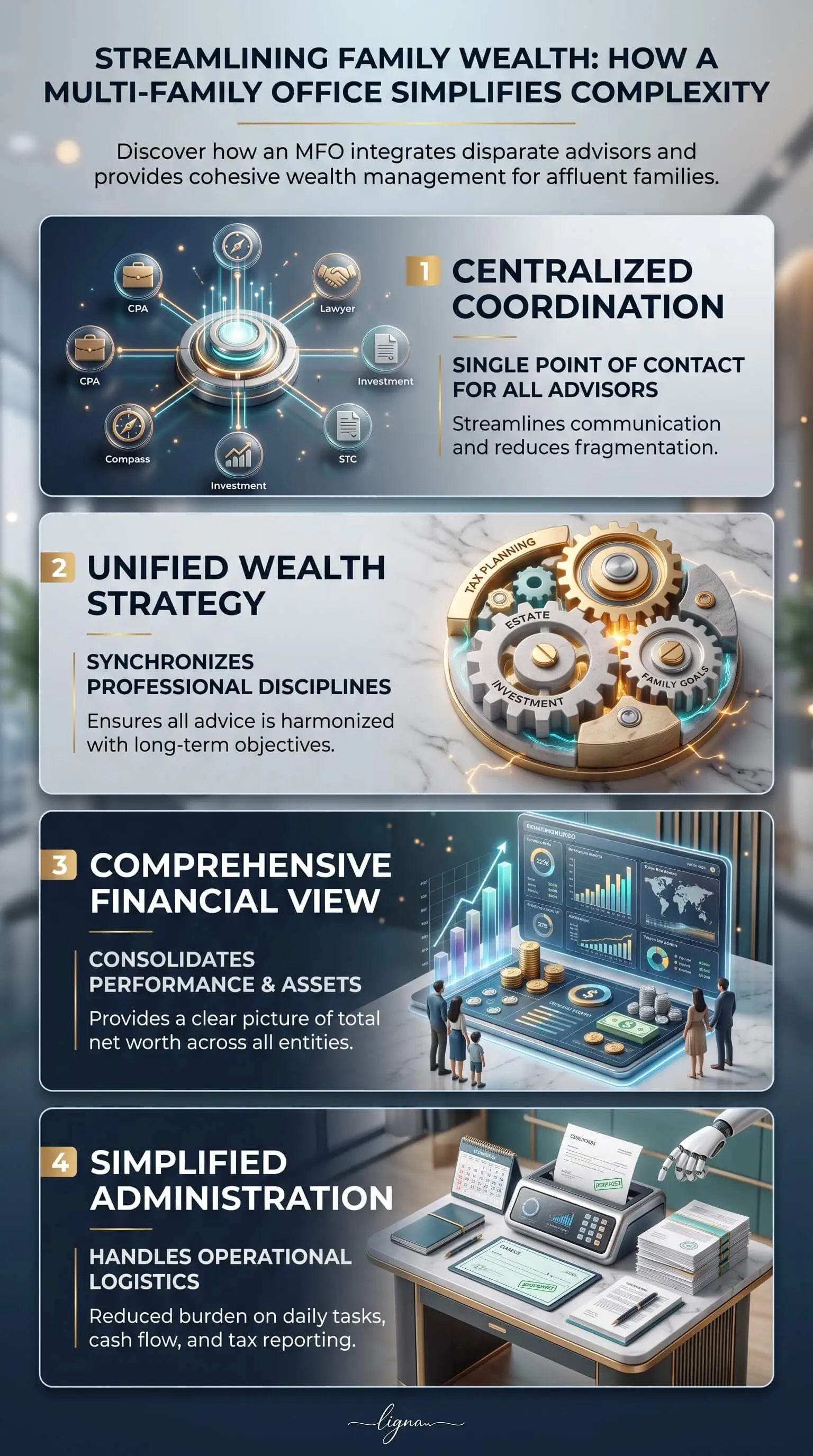
Multi-family office wealth management services give a family with significant wealth one coordinated team that manages investments and aligns the CPA, estate attorney, trustee, and other advisors around a single strategy. The model is a shared version of the family office approach, and its value comes from coordinating decisions across the full balance sheet.
What it covers: investment oversight, tax and estate coordination, trust oversight, family governance, philanthropy, and consolidated reporting
Why it helps a family with too many advisors: one team owns the follow-through, so the family stops relaying messages between specialists
What it does not do: replace your CPA, attorney, or trustee
Who it fits: families whose wealth spans trusts, entities, business interests, or several generations, generally $10 million or more at Legacy Bridge
How firms charge: an asset-based fee, a flat retainer, or a hybrid of the two
Top Takeaways
More advisors usually means more gaps between specialists, with no one owning the full picture.
A multi-family office coordinates the CPA, estate attorney, investment managers, and trustee around one strategy.
It works alongside the advisors a family already trusts instead of replacing them.
In the first 90 days, families typically get a consolidated balance sheet and a named owner for every open item.
Before hiring one, confirm the firm acts as a registered fiduciary and find out exactly how it is paid.
What Are the Signs Your Family Has Too Many Advisors?
Try a simple test. Ask how much liquidity the family has today across every account, trust, and entity. If nobody can answer without calling someone else first, the advisory structure has outgrown itself.
Other signs we see often:
Your CPA and investment manager have given advice that conflicts, and no one has reconciled it
There is no single report showing assets, liabilities, trusts, and entities together
Nobody has reviewed the trust documents since the family signed them
Tax surprises show up at filing time instead of during the year
Open items sit for months because each advisor assumes another one owns them
Adult children would not know who to call if something happened tomorrow
Families with children in private school often notice it first around education. Tuition funding, grandparents' gifts, and an education trust can end up with three different advisors, none of whom sees what the others are doing. The tax considerations for private school tuition alone can involve the CPA, the estate plan, and the investment accounts in the same year.
Why More Advisors Can Mean More Gaps
Each advisor can be right within their own lane while the overall plan drifts, because the gaps open between the lanes.
An estate attorney drafts a trust, and the investment manager never hears that it needs funding. Months later, the CPA learns about a large gift after year-end. Nobody made a mistake. The plan still failed to work the way the attorney designed it.
The cause is coordination rather than competence, which makes this a decision-quality problem. When advice arrives in pieces, families end up deciding with partial information even when every advisor on the team is excellent, making multi family office wealth management services especially valuable for keeping every part of the family's financial life aligned.
How Does a Multi-Family Office Bring Your Advisors Together?
A multi-family office acts as the family's financial command center, making sure the right information reaches the right professional before a decision is made. For each advisor, the gaps look a little different:
CPA: Mid-year tax effects of trades, gifts, and trust distributions often go unseen until filing. We keep tax visible all year so fewer surprises reach the return.
Estate attorney: Trust funding, titling, and beneficiary designations can stall once documents are signed. We track execution until the plan works as drafted.
Investment manager: Liquidity needs and trust purposes may never reach the portfolio. We connect investment decisions to the rest of the plan.
Trustee: Family priorities and beneficiary context get lost easily. We keep trustees, beneficiaries, and advisors talking.
Insurance advisor: Coverage tends to lag as assets and entities grow, so we tie periodic reviews to the balance sheet.
In our experience, the first 90 days follow a steady sequence:
Gather statements, tax returns, estate documents, trust agreements, and insurance policies.
Build one consolidated balance sheet showing ownership, liquidity, risk exposure, and upcoming obligations.
Review trusts, tax exposure, and estate documents to separate what is current from what is outdated.
Give every open item and workstream a named owner.
Set a regular rhythm for meetings and reporting.
Business owners will recognize the logic from how a fractional CFO brings financial clarity to a growing company. Here, the enterprise being organized is the family's wealth.
Does a Multi-Family Office Replace Your CPA or Estate Attorney?
No. A strong multi-family office works alongside the professionals a family already trusts. Most of the families we work with keep their CPA and attorney, and they stop serving as the go-between.
Who Is a Multi-Family Office Right For?
The fit is strongest when wealth spans trusts, entities, business interests, real estate, or more than one generation. Legacy Bridge generally works with families managing $10 million or more, and we judge fit by complexity rather than a single threshold. As an independent, SEC-registered fiduciary based in West Des Moines, Iowa, we serve families nationally and build our advice around the family's interests instead of a product shelf.
Fees for multi-family office wealth management services are usually asset-based, a flat retainer, or a hybrid of the two. Weigh that cost against what fragmented advice may already be costing in missed planning and avoidable surprises, especially when outsourced business and financial accounting firms are part of the broader advisory structure.
"When a family tells us they have too many advisors, we almost never suggest letting anyone go. The advisors are usually good at what they do. What the family lacks is one person who owns the whole picture. Once our team keeps the balance sheet current and brings the CPA and attorney into the same conversation, the noise drops within a few months. After that, the family spends its time making decisions instead of managing advisors."
Essential Resources
We point families to these sources when they want to check credentials, compare advisory models, or understand how the pieces of a plan fit together.
SEC Investment Adviser Public Disclosure: Look up any registered adviser. Each firm's Form ADV shows how it is paid, where conflicts may exist, and any disciplinary history.
Investor.gov: Check Out Your Investment Professional: Run a background check. The SEC's investor site walks through looking up advisers and brokers and explains what a relationship summary should cover.
CFP Board: Verify a CFP Professional: Confirm a planner's certification. You can see whether someone currently holds the CFP mark and whether the CFP Board has publicly disciplined them.
Morgan Lewis: Control, Cost, and Complexity: Compare family office structures. This July 2026 analysis looks at single-family, multi-family, hybrid, and outsourced models, and warns against choosing by asset size alone.
Brown Brothers Harriman: What Is a Multi-Family Office?: See why coordination sits at the center. BBH describes how an MFO pairs shared infrastructure with advice built around each family.
Wikipedia: Multi-Family Office: Get a neutral overview. A short summary of what multi-family offices typically handle, from estate planning to coordinating outside professionals.
IRS: Donor-Advised Funds: Learn how a common giving vehicle works. Helpful background when philanthropy is part of the family's plan.
Supporting Statistics
Cerulli Associates projects $124 trillion in U.S. wealth will change hands through 2048, with $18 trillion going to charity. Each of those transfers involves estate counsel, tax planning, trustees, and the investment team at the same moment, and that is where uncoordinated advice tends to break down. Source: Cerulli Associates
About 2% of households, the high-net-worth and ultra-high-net-worth segment, are expected to account for roughly $62 trillion of that total. Most of the planning complexity sits with a small group of families. Source: NAPA summary of the Cerulli report
More than 106,000 people in the United States currently hold CFP certification. With that much credentialed expertise available, families rarely struggle to find a qualified advisor. The harder part is finding someone accountable for how all of that advice fits together. Source: CFP Board
These statistics show that complex wealth transfers often involve multiple advisors at once, making outsourced family office executive services valuable for coordinating estate, tax, trustee, and investment decisions under one accountable structure.
Final Thought and Opinion
In our view, the answer to too many advisors is one team accountable for the whole picture, and it rarely involves trimming the roster.
The turning point rarely looks dramatic. Someone asks a simple question about liquidity or trust distributions, and it takes three phone calls to get an answer. That moment says more about the advisory structure than any single recommendation ever could.
A few things we have seen hold true across the families we serve:
Conflicting advice almost always traces back to coordination, and the advisors themselves are rarely the problem.
One consolidated balance sheet improves every conversation that follows it.
Open items get finished once somebody's name is attached to each one.
Families usually feel the difference within the first few months, long before any long-term results can be measured.
Private schools know this principle well. Many rely on accounting support that brings transparency to their finances, and a family with complex wealth deserves the same visibility into its own affairs.
A multi-family office earns its place when every advisor you already trust becomes more effective because someone is finally connecting their work.
Frequently Asked Questions
What does a multi-family office do for a family with many advisors?
It serves as the family's central coordinator. The team builds one view of assets and liabilities, reviews trust, tax, and estate plans for gaps, and assigns an owner to every open item so all of the advisors work from the same information.
Will a multi-family office replace my CPA, attorney, or trustee?
Usually not. A strong multi-family office works alongside the professionals a family already trusts, coordinating their advice and tracking follow-through so decisions reflect the full balance sheet.
How is a multi-family office different from a wealth manager?
Scope is the difference. A traditional wealth manager usually concentrates on investments and financial planning, while a multi-family office also coordinates tax strategy, estate planning, trusts, family governance, philanthropy, and reporting through one relationship.
How much wealth do you need for a multi-family office?
Many multi-family offices design their services for families with $25 million or more in investable assets. Legacy Bridge generally works with families managing $10 million or more, and the complexity of the family's wealth matters more to us than any single number.
How are multi-family offices paid?
Most charge a percentage of assets under management, a flat annual retainer, or a mix of the two. Before you sign, ask the firm to state its fees plainly, put its services in writing, and disclose any conflicts.
What should I ask before hiring a multi-family office?
Start with whether the firm acts as a fiduciary and how it is compensated, including any revenue from products or third parties. Then ask how it works with outside attorneys and CPAs, who your day-to-day contact will be, and who is accountable for tracking open planning items.
Next Steps
If your family's advice has started to feel scattered, an afternoon with your own paperwork will show you where the gaps are:
Write down every advisor your family uses and what each one is responsible for.
Mark any recent recommendations that conflicted or were never resolved.
Pull your latest statements, tax returns, trust agreements, and estate documents into one folder.
Look up each adviser's registration and fiduciary status before your next review meeting.
Schedule a private consultation to see how Legacy Bridge would coordinate the team you already have.
Most families do not need more advice so much as a way to turn the advice they already receive into one clear plan, which is where family office trust and business transition services can help bring greater coordination and continuity.
One call. One team. One coordinated strategy.