Your best month of the year just closed, and payroll is due Friday with not enough in the account to cover it.
We've heard some version of that story many times across more than 150 Accountix clients since 2015. Usually the business itself is fine. The books simply stopped telling the owner what was going on, and nobody noticed until the money ran short. Outsourced bookkeeping services prevent exactly that kind of surprise, along with errors that compound month after month, IRS penalties, fraud that goes unnoticed and decisions made from a bank balance. A team that reconciles and reviews your books every month catches each of these while it's still small.
Bookkeeping sounds simple on paper: record what comes in and what goes out. In our experience, trouble starts in the part nobody checks. Independent education consultants and small private schools run on margins as thin as any shop or agency, so they often feel it first.
TL;DR Quick Answers
Outsourced Bookkeeping Services
Outsourced bookkeeping services give a small business an outside team that records transactions, reconciles every account and closes the books each month, without the cost of an in-house hire. At Accountix, we treat that monthly close as prevention. It's where cash flow gaps, errors, missed filings and fraud show up while they're still small and cheap to fix.
What the team handles:
Record and categorize every transaction in cloud-based systems that work alongside your existing tools
Reconcile every bank and credit card account monthly
Close the books on a set schedule with a profit and loss statement and balance sheet
Review entries with a second set of eyes before they reach your CPA
Track contractor payments for Form 1099-NEC and hand off clean books at tax time
Scale up to outsourced accounting or fractional CFO support as you grow
Cost: Accountix bookkeeping starts at $200 per week, scoped after a 30-minute intro call.
Best fit for: owners who decide spending from the bank app, books that close late, or businesses where one person handles every payment.
Top Takeaways
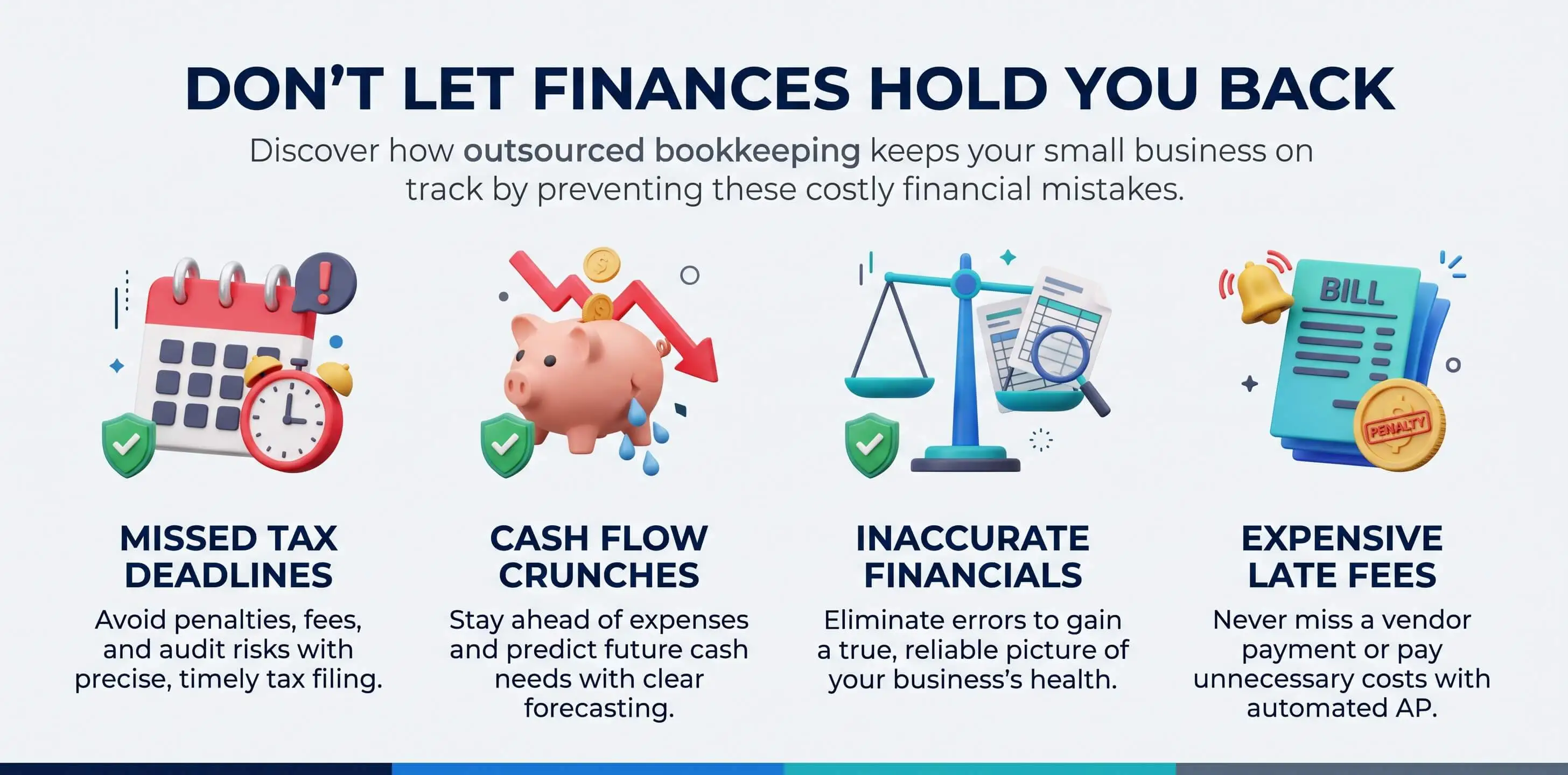
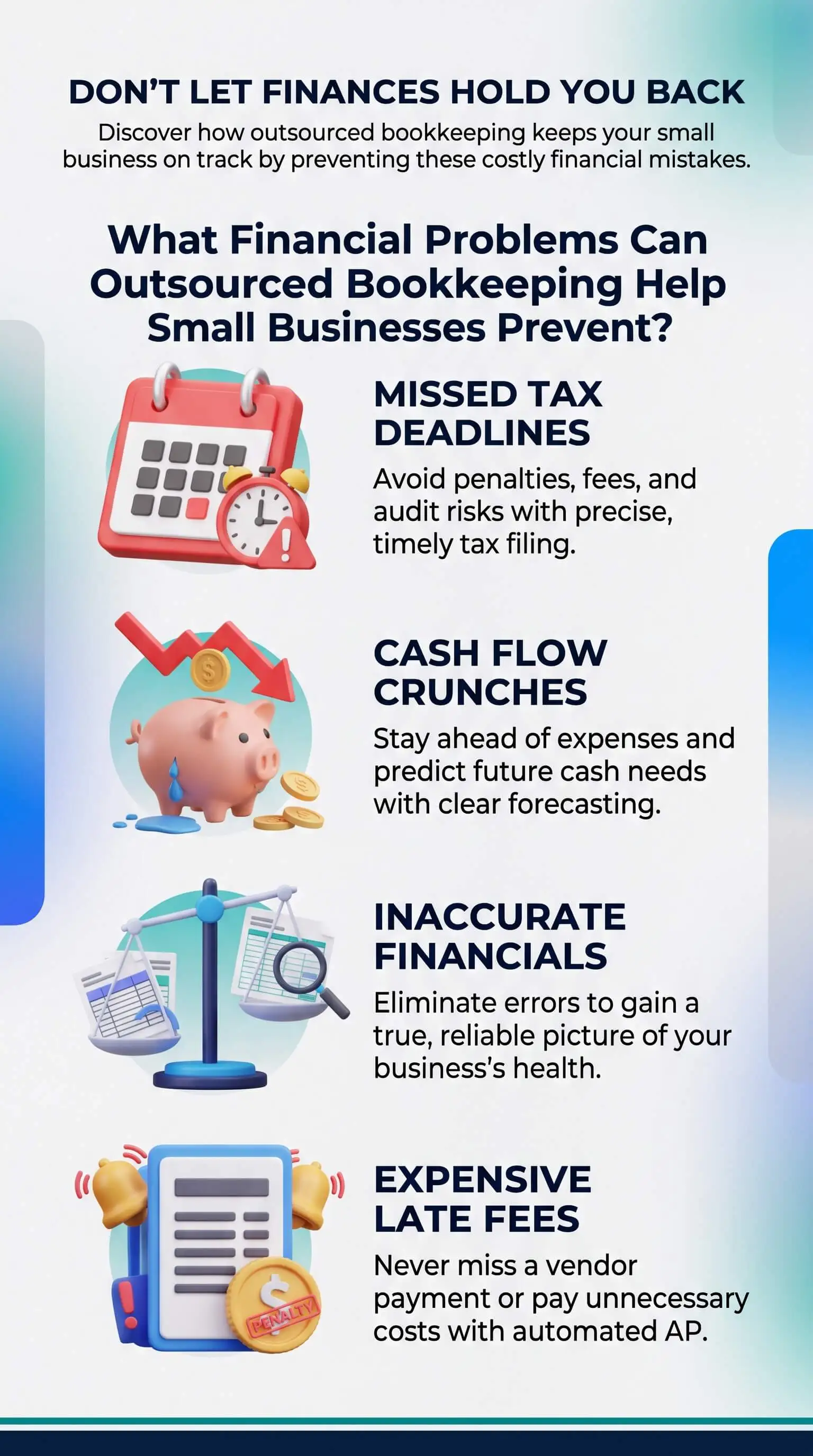
Outsourced bookkeeping services prevent cash flow surprises, compounding errors, IRS penalties, unnoticed fraud and decisions made on bad numbers.
Monthly reconciliation of every bank and card account is the single most effective habit for catching problems early.
A second person reviewing the books closes the gap that most small business fraud slips through.
Clean, current financial statements make tax season, loan applications and pricing decisions far easier.
Prevention costs less than cleanup, so the best time to fix your bookkeeping is before the books fall behind.
The Financial Problems Outsourced Bookkeeping Prevents
Most money problems in a small business build quietly, in accounts nobody reconciled and entries nobody reviewed. These are the seven we run into most.
1. Cash Flow Surprises
A cash flow surprise happens when the business looks healthy on paper but runs short the day a bill comes due. It usually starts with unreconciled bank accounts and invoices nobody chased. Reconcile every account monthly, review receivables weekly, and you'll see the gap weeks before payroll does.
2. Bookkeeping Errors That Compound
A miscategorized expense or a duplicate entry seems minor in March. By December it has worked its way into every report, every budget and your tax return. Catch it during a second-person review at the monthly close, though, and the fix takes minutes.
3. IRS Penalties and Missed Filings
Late returns, missing 1099-NEC forms for contractors and deductions you can't support all invite penalties. The IRS accuracy-related penalty alone adds 20% of the underpaid tax, and interest runs on top of that. Your CPA can only file accurately and on time with current, documented books to work from.
4. Fraud and Theft That Goes Unnoticed
Picture one person who writes the checks, records them and reconciles the account. Nobody else ever sees the full picture. That setup is the classic opening for theft, and it's common in small teams built on trust. Outsourced bookkeeping services split those duties and add an outside reviewer who spots an unfamiliar vendor or a missing receipt.
5. Decisions Made From a Bank Balance
Without a monthly close, plenty of owners decide what to spend by opening the bank app. A bank balance won't show what you owe, what you're owed or which services actually make money. Monthly financial statements give you something solid to price and hire from.
6. Commingled Personal and Business Funds
Running business costs through a personal card, or the other way around, blurs which expenses are deductible and leaves the books harder to defend. We flag mixed transactions every month so the two stay separate.
7. Financing Roadblocks
Lenders want current financial statements before they'll approve a loan or line of credit. In the Federal Reserve's 2026 Report on Employer Firms, owners who didn't apply because they expected a denial most often blamed weak business finances. Clean, closed books let you move quickly when a slow season or an opportunity calls for capital.
How Outsourced Bookkeeping Services Stop Each Problem Before It Starts
Every one of these problems gives off an early warning sign, and each has a specific control that stops it.
Cash flow surprises: Overdrafts or late vendor payments are usually the first sign. Monthly bank reconciliation and a weekly receivables review head them off.
Compounding errors: When reports don't match the bank, errors are already spreading. A second-person review during the close catches them.
IRS penalties: Your CPA asking for cleanup at tax time is the tell. Year-round categorization and contractor tracking fix it.
Fraud and theft: Watch for unfamiliar vendors and missing receipts. Separation of duties and an outside reviewer close the gap.
Bank-balance decisions: No monthly profit and loss statement means you're guessing. A monthly close ends the guesswork.
Commingled funds: Personal charges keep turning up in business accounts. Flagging mixed transactions each month keeps them apart.
Financing roadblocks: Statements are months out of date. Closing the books on a set schedule keeps them ready for a lender.
Warning Signs Your Books Are Already Creating Problems
If more than one of these sounds familiar, the problems above are likely already forming:
Your books close more than 30 days after month-end, or not at all.
Nobody has reconciled some of your bank or credit card accounts in months, or ever.
Your CPA asks for cleanup work every tax season.
You check the bank app to decide whether you can afford something.
Business expenses regularly land on a personal card.
One person knows every password and handles every payment.
You couldn't produce a current balance sheet if a lender asked today.
Why Small Education Businesses Feel These Problems First
Tuition, deposits and donor gifts rarely arrive on the same schedule as rent and payroll. That timing gap makes cash flow problems show up early for small private schools and independent consultants. Schools that also track restricted gifts need clean fund-level records, which is why accounting support for private school nonprofits matters so much. Consultants juggling retainers and hourly work should also understand how consultants bill clients, since every invoice becomes a receivable someone has to track. And if you're still deciding who should handle the work, our comparison of choosing between a freelancer and a bookkeeping team walks through the tradeoffs.
"When we take over a new client's books, the problem that brought them to us is almost never new. Usually it was sitting in an unreconciled account or an unreviewed payroll entry six or eight months earlier, in plain sight. Nobody had time to look. Cleanup after the fact almost always costs more than steady monthly upkeep would have, and it costs the owner sleep too. Most prevention is unglamorous: the same checks, done every month, by someone whose job is to notice."
7 Essential Resources
When owners ask us where to read more, these are the pages we send them to.
Federal Reserve Banks: 2026 Report on Employer Firms. Survey data from more than 6,500 small employers on cash flow strain, operating costs and how owners cover shortfalls.
IRS: Accuracy-Related Penalty. Explains how the 20% penalty is calculated and why interest keeps adding to it until it's paid.
IRS: Recordkeeping for Small Businesses. What records to keep, how long to keep them and why the burden of proof sits with you.
IRS: About Form 1099-NEC. The form for reporting payments to independent contractors, one of the filings small businesses miss most often.
ACFE: Occupational Fraud 2024, A Report to the Nations. The largest global study of employee fraud, with benchmarks by organization size and the controls that reduce losses.
SBA: Manage Your Finances. A plain-language overview of balance sheets, accounting methods and the tasks someone must own, from receivables to bank reconciliation.
SBA: Open a Business Bank Account. Why separating business and personal funds protects you, and what you need to open an account.
Read together, these sources make a strong case for monthly reconciliation and solid internal controls long before tax season. That steady monthly work is exactly why so many owners rely on outsourced bookkeeping services instead of squeezing it into their own week.
3 Statistics
54% of small employer firms that faced a financial challenge covered it with the owner's personal funds, the most common response in the Federal Reserve's 2026 Report on Employer Firms. When the books don't flag a shortfall early, the owner's savings often become the backstop. Source: Federal Reserve Banks, 2026 Report on Employer Firms
More than half of occupational fraud cases trace back to missing internal controls, at 32% of cases, or to someone overriding the controls already in place, at 19%, according to the ACFE's 2024 Report to the Nations. The same study puts the median loss for organizations with fewer than 100 employees at $141,000 [VERIFY]. Source: ACFE, Occupational Fraud 2024
The IRS accuracy-related penalty is 20% of the underpaid tax tied to negligence or a substantial understatement, and the IRS charges interest on the penalty too. Accurate, documented books are the simplest way to stay clear of it. Source: IRS
Side by side, these numbers show how quickly a bookkeeping gap becomes an out-of-pocket cost, whether it lands on the owner's savings or arrives as a tax bill. If you're weighing support, it's also worth seeing what outsourced accounting services for small firms typically cover.
Final Thoughts and Opinion
The costliest financial problems we see are rarely dramatic. Most started as small, ignored items that compounded for months, like an account nobody reconciled or a personal card that slowly turned into a business card.
A few patterns show up again and again:
Owners trust a healthy bank balance more than they should, even though it hides what's owed and what's coming.
Most small business fraud we've seen wasn't clever. It went unchecked because one person did everything.
Cleanup almost always costs more than the monthly upkeep that would have prevented it.
The smoothest transitions belong to owners who switch before the books fall behind.
While you don't need a full finance department to avoid these problems, you do need the right checks done every month by people whose job is to notice, such as an experienced Santa Barbara bookkeeper. Once your books are clean and current, fractional CFO support is the natural next step for turning accurate numbers into a plan for growth.
Frequently Asked Questions
What financial problems does outsourced bookkeeping prevent?
Outsourced bookkeeping prevents cash flow shortfalls, recurring bookkeeping errors, IRS penalties, unnoticed fraud, commingled funds and decisions based on incomplete numbers. It works by reconciling accounts, reviewing entries and closing the books on a set schedule each month, so problems surface while they're still small and inexpensive to fix.
How do outsourced bookkeeping services improve cash flow?
Outsourced bookkeeping services improve cash flow by keeping receivables, payables and bank balances current. When your bookkeeper reconciles every account monthly and flags overdue invoices, you can see a shortfall weeks ahead instead of discovering it the day payroll is due.
Can outsourced bookkeeping help me avoid IRS penalties?
Yes. Accurate, documented books give your CPA what they need to file correctly and on time. Bookkeepers also track contractor payments for Form 1099-NEC and keep receipts organized, which helps you support deductions and avoid the 20% accuracy-related penalty.
Does outsourcing bookkeeping reduce the risk of fraud?
It does. Outsourcing separates duties so one person no longer writes, records and reconciles every payment. An outside reviewer is also more likely to notice unfamiliar vendors, duplicate payments or missing receipts that an overstretched internal team might miss.
How much do outsourced bookkeeping services cost for a small business?
Cost depends on how many transactions you have and how complex they are. At Accountix, bookkeeping starts at $200 per week, and we scope every engagement after an intro call. For many small businesses that come in under the salary, benefits and software of an in-house hire, which is part of why an outsourced accounting firm can support growth without adding headcount.
When should a small business switch to outsourced bookkeeping?
The right time is usually before the books fall behind. Common signals include unreconciled accounts, a late monthly close, cleanup requests from your CPA or one person holding every financial process. If any of these sound familiar, it's worth a conversation now.
Stop Small Bookkeeping Problems Before They Grow
If one or two of the warning signs above sound familiar, now is the easiest time to act, while the fixes are still small. Book a 30-minute intro call with Accountix. Our Santa Barbara-based team works with growing businesses nationwide, and we'll look at how your books run today and tell you plainly what we see. It's a conversation with no sales pitch, just clarity.


